UMA OPINIÃO BAMBA!

UMA OPINIÃO BAMBA!

Textos Interessantes e Curiosidades, Humor, Seinfeld, Política, Economia, Negócios, SPFC, Esportes, próprios ou não, mas sempre dando o devido crédito. Ou não?

quinta-feira, 19 de janeiro de 2012

Obama ordena aumento do número de vistos para Brasil e China


19/01/2012 16h45 - Atualizado em 19/01/2012 18h46

Obama ordena aumento do número 


de vistos para Brasil e China


País deve aumentar capacidade de processamento em 40% em um ano.
Ministérios devem preparar plano que atenda 80% dos pedidos em 60 dias.


Da France Presse


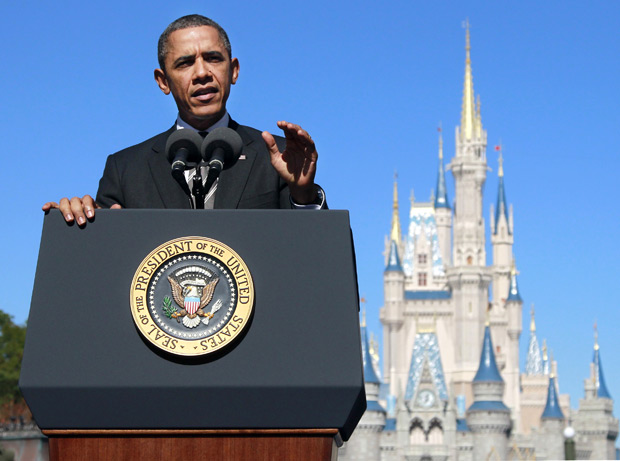
Os Estados Unidos devem aumentar a capacidade de processamento de vistos para Brasil e China em 40% nos próximos 12 meses, ordenou nesta quinta-feira (19) o presidente Barack Obama, como parte de um pacote de estímulo turístico para seu país, anunciado na Disney World, na Flórida.

A ordem executiva divulgada pela Casa Branca pediu aos ministérios envolvidos para que preparem um plano em 60 dias que assegure que "80% das solicitações de vistos sejam atendidas em até três semanas" nesses dois países, salvo exceções que envolvam a segurança do país.

O presidente Barack Obama no seu discurso sobre turismo, nesta quinta (19), durante visita à Disney World, na Flórida  (Foto: Haraz N. Ghanbari / AP)O presidente Barack Obama no seu discurso sobre turismo, nesta quinta (19), durante visita à Disney World, na Flórida (Foto: Haraz N. Ghanbari / AP)

"As pessoas querem vir aqui. E China e Brasil são dois dos países com o maior acúmulo [de pedidos de vistos]. Então isso é o que estamos fazendo - dizendo ao mundo que a América está aberta aos negócios", discursou o presidente, segundo o jornal "Chicago Tribune".

Os requisitos para os turistas e homens de negócios estrangeiros têm sido motivo de queixas por parte de alguns países emergentes, que não pertencem ao chamado programa de isenção de vistos, o qual beneficia a maioria dos países europeus e as nações ricas e aliadas dos Estados Unidos.

Altos funcionários diplomáticos já anunciaram em novembro que aumentarão o número de funcionários nas embaixadas de Brasil e China devido a grande demanda de vistos.

Dos 820.000 brasileiros que pediram permissão para viajar aos Estados Unidos entre outubro de 2010 e setembro de 2011 (ano fiscal americano), 791.000 a obtiveram.

A demanda superou em 40% a cifra do ano anterior.

Os Estados Unidos concederam 885.000 visas a chineses, ante mais de um milhão de solicitações durante o mesmo período, num aumento de demanda de 34%.

Crescimento
Segundo cálculos citados pela Casa Branca, o crescimento das classes médias na China, Brasil e Índia devem provocar um aumento do número de viagens para esses países de 135%, 274% e 50%, respectivamente, até 2016.

O Departamento de Comércio calcula que os turistas chineses gastam mais de US$ 6 mil quando viajam aos Estados Unidos, com todo incluso, e os brasileiros cerca de US$ 5 mil.

A ordem presidencial acontece num contexto de perda de mercado internacional, explicou a Casa Branca.

"A participação do mercado americano no gasto dos turistas internacionais caiu de 17% para 11% entre 2000 e 2010", explicou o comunicado emitido pelo governo que detalha as medidas.

Ante esta situação, Obama anunciou seu objetivo de fazer dos Estados Unidos o primeiro destino turístico mundial para impulsionar a criação de empregos dentro do setor, informou a Casa Branca.

"Quanto mais gente visita os Estados Unidos, mais americanos voltam a trabalhar", disse o presidente em um comunicado após firmar um decreto convocando várias agências federais a tomar medidas para estimular a atividade turística no país.


O mundo é dos insetos revela o mais novo censo da vida selvagem


O mundo é dos insetos revela o mais novo censo da vida selvagem


Eles representam mais da metade das 19 mil espécies recém-descobertas


O GLOBO - Publicado: 19/01/12 - 15h59


 Insetos estão entre os animais mais descritos por cientistas em 2009 Foto: Reprodução

Insetos estão entre os animais mais descritos por cientistas em 2009REPRODUÇÃO


RIO - Os besouros continuam na moda. Esta foi a maior ordem de insetos recém-descobertos por cientistas em 2009, ano da compilação mais recente: 3.485 novos coleópteros foram oficialmente descritos.

Entre 19.232 espécies descobertas, mais da metade foram de insetos (9.738 novos bichos). O relatório de 2011 da State of Observed Species (SOS) foi divulgado nesta quarta-feira pelo International Institute for Species Exploration, do Arizona, Estados Unidos.

Em seguida, aparecem as plantas vasculares, totalizando 2.184 exemplares ou 11,3% do total das novas espécies descritas. Houve, ainda, sete aves, 41 mamíferos e 1.487 aracnídeos: aranhas ou ácaros.

As descobertas representam um acréscimo de 5,6% dos animais conhecidos pela ciência, na comparação com 2008. Já em relação à época em que o botânico sueco Carolus Linnaeus começou seu trabalho de classificação de plantas e animais, iniciando o uso do sistema de taxonomia moderno, há 250 anos, o número atual da espécies conhecidas é duas vezes maior, explica o autor do relatório, o entomologista Quentin Wheeler.

- O conhecimento acumulado de espécies desde 1758, quando Lineu estava vivo, é de quase 2 milhões de espécies, mas ainda há muito a ser feito - disse Wheeler. - Um palpite razoável é que dez milhões de plantas e espécies ainda precisam ser descobertas por pesquisadores.

Quanto aos mamíferos, foram 41 espécies novas. Destes, 83% ou eram morcegos (44%) ou roedores (39%). Entre os anfíbios, 90% eram sapos. Já em relação aos crustáceos, 31,8% das novas espécies eram da ordem que inclui lagostas, caranguejos, lagostas e camarão.


Economists: A Profession at Sea


Economists: A Profession at Sea

How to keep economists from missing the next financial crisis.

Illustration by O.O.P.S. for TIME
ILLUSTRATION BY O.O.P.S. FOR TIME


After the financial crisis of 2008, the Queen of England asked economists, "Why did no one see the credit crunch coming?" Three years later, a group of Harvard under graduate students walked out of introductory economics and wrote, "Today, we are walking out of your class, ­Economics 101, in order to express our discontent with the bias inherent in this introductory economics course. We are deeply concerned about the way that this bias affects students, the University, and our greater society."

What has happened? Rebellion from both above and below suggests that economists, who were recently at the core of power and social leadership in our society, are no longer trusted. Not long ago, the principal theories of economics appeared to be the secular religion of society. Today, economics is a discipline in disrepute. It's as if our ship of state broke from its stable mooring and unexpectedly slammed into the rocks. How could things have gone so spectacularly wrong? And what can be done to repair economics so economists can play a productive role in helping society?

As the Oscar-winning documentary Inside Job illustrated, there is a very lucrative market for false visions of financial-market behavior that legitimate the desires of participants to be unshackled and make more money. But good policy prescriptions are public goods that represent the social good and not just the concentrated financial interests. Unfortunately, as economists beginning with the work of Adam Smith have repeatedly shown, public goods are under provided in the marketplace. In addition, the reputation of the economics profession is itself a collective good, and those who have tarnished it are not adequately penalized for the damage they do to their fellow professionals when they accept large sums of money in return for marketing a perspective that benefits vested interests.

These are problems that some within economics have been aware of for a long time, but the discipline as a whole has been unable to address them. The onus is on the profession to face these challenges and help lead society off the rocks.

How to Save Economics

first, economists should resist overstating what they actually know. The quest for certainty, as philosopher John Dewey called it in 1929, is a dangerous temptress. In anxious times like the present, experts can gain great favor in society by offering a false resolution of uncertainty. Of course when the falseness is later unmasked as snake oil, the heroic reputation of the expert is shattered. But that tends to happen only after the damage is done.

Second, economists have to recognize the shortcomings of high-powered mathematical models, which are not substitutes for vigilant observation. Nobel laureate Kenneth Arrow saw this danger years ago when he exclaimed, "The math takes on a life of its own because the mathematics pushed toward a tendency to prove theories of mathematical, rather than scientific, interest."

Financial-market models, for instance, tend to be constructed with building blocks that assume stable and anchored expectations. But the long history of financial crises over the past 200 years belies that notion. As far back as 1921, Frank Knight of the University of Chicago made the useful distinction between measurable risk and "unknown unknowns," which he called radical uncertainty. Knight's point was that in a period of radical uncertainty, expectations couldn't be anchored because they have nothing to latch onto. Financial theories and regulatory designs that hinge on the assumption of stable and anchored expectations are not resilient enough to meet the challenges presented by real financial markets in radically uncertain times.

The third remedy for repairing economics is to reintroduce context. More research on economic history and evidence-based studies are needed to understand the economy and overcome the mechanistic bare-bones models the students at Harvard objected to being taught.

But the economic orthodoxy continues its romance with the Enlightenment tradition of Cartesian "universal laws." This began after the Thirty Years' War, when society demanded both a method of investigation that did not antagonize religious factions and universal abstract laws and principles that could be objectively proven. Lost to the traumas of religious and social turmoil were the humble and pragmatic humanistic approaches of Francis Bacon and Michel de Montaigne and the suppleness of William Shakespeare. Reorienting economics away from the Enlightenment glamour of high theory and returning it to focusing on real problems, in the same way a clinical physician does, would make economics more relevant.

The profession needs to realign the incentives for doing reputable research in order to protect its integrity as a whole, as is done in medicine. Recent policies announced by the American Economic Association on disclosing conflicts of interest are a step in a healthy direction. Faculty members should also be forced to step down from consulting at the time they receive tenure.

Fourth, we must acknowledge the intimate, inseparable relationship between politics and economics. Modern debates about who caused the financial crisis— government or the private financial sector—are almost nonsensical. We are living in an era of money politics and large powerful interests that influence the laws and regulations and their enforcement. In order to catalyze the evolution of economics, research teams would benefit from multidisciplinary interaction with politics, psychology, anthropology, sociology and history.

Such interdisciplinary communication would also benefit another neglected area of economics: the study of macroeconomic systems. Psychologists mock what economists call the micro­foundations of consumer behavior—a set of assumptions based on the idea that isolated individuals behave with clear knowledge of the future. That this framework is suitable for aggregate systems in a globalized economy simply because the tribe called economics has agreed to adhere to these ad hoc assumptions makes no sense. Increased interactions with disciplines that economists have often mocked as unscientific would greatly improve economists' understanding of the real world and would be more truly scientific.

Many of these suggestions have been argued within the profession as far back as the formation of the American Economic Association in the late 19th century. Its committee on graduate economics education, a panel created in the early 1990s to take stock of the field, as well as the work of economist David Colander and others, has repeatedly illuminated these concerns with economic method and education. It is only now, with the force of recent events so damaging to societies everywhere on earth, and with the rise of developing countries that see the shortcomings of the economic orthodoxy's prescriptions, that the resistance to renewing the economics profession may be overcome. Until then, we are really at sea without an anchor.

Johnson is the executive director of the Institute for New Economic Thinking in New York City and a former managing director at Soros Fund Management. He also serves on the U.N. Commission of Experts on International Monetary Reform


Alexandre Meireles - Casa de São Lázaro - LAR Verdadeiro


  • Ricardo Bampa Alê, Parabéns a todos! Como sempre, me surpreende e me ensina! Humildemente agradeço a tudo e me coloco à disposição. Você é um grande amigo! Abs.
    há 6 horas · 


(http://www.facebook.com/permalink.php?story_fbid=2862739480500&id=1020094019&ref=notif&notif_t=like)


Para quem não sabe, gira grande é o encontro de todos os trabalhadores da casa, e dia de ver o terreiro rodeado de saias brancas e panos de cabeça, na própria ou na cintura.

É dia de muito calor dentro da casa, muito mais que termico, calor humano, dia de encontro, reencontro, abraços, fofocas, apresentações, explicações, causos e broncas.

Esta gira grande do dia 20 tem um sabor diferente, é a despedida da (como nomeou Mãe Paula) CASA AMARELA. Vamos para uma nova etapa.

Casa esta que abrigou, 23 festas do grande Oriente, 11 festas de Exu,inumeras festas de Orixá, 11 festas de cosme e damião, 10 aguas de Oxalá,Nasceram mais de 26 pais e mães no santo, muita gente tomou cargo, foram batizados 426 novos umbandistas, Ogum rodou(por baixo) 1.000 vezes no terreiro, descarregando e trazendo força e encantamento a milhares de pessoas.

Nesta casa nasceram amores, relacionamentos se romperam, crianças nasceram(e muitas) aprendendo a bater cabeça e tambor para os Orixás e guias. Minha fraca memoria( e me perdoem) só lembro do ritual de casamento de Mãe Edina e Fabio, que se conheceram e se amaram na casa.

Nesta casa nos despedimos de Sergio Gravina, Pai Tico, D. Mariazinha, a mãe da Camila Marra, e me vem um nó na garganta só de escrever isso, saudade..., porém, graças a Deus, dos mais de 2.000 médiuns que passaram por esta casa amarela nos últimos 10 anos... nosso povo esta vivo!!!! e espero que tenham levado algo de bom da casa.

Também foi ai neste endereço, que centenas de pessoas foram curadas no corpo fisico, foi ai que vencemos em corrente, fé e muito trabalho, dezenas de batalhas contra o cancer e outras doenças.

Centenas de noites avançando a madrugada, com trabalhos e ensinamentos dos guias.

Neste endereço, nasceu a casa da Alemanha, de Uberlândia, da Praia Grande,, da Cachoeira Dourada e ainda outros foram e abriram suas casas... A Umbanda em expansão!!!!

Nesta casa aconteceram aproximadamente 2.880 giras, fora os trabalhos extras, aconteceram aproximadamente 75.000 atendimentos(por baixão), 1.716 desobssessões (baixão também) e milhares....(e é verdade), milhares de milagres.

E sei que muitos de vocês que estão lendo esta carta, são os portadores destes milagres.
Quando falo da casa e estas estatisticas estou me referindo ao endereço da avenida cupecê,1.090, ainda temos mais 6 anos de trabalhos anteriores com outros numeros(grandes também) para somar.

A tudo isto dou o nome de ... AXÉ, AMOR, DEDICAÇÃO E VERDADE.

Sou fruto de um milagre da casa de São lázaro, e isto aconteceu há 23 anos, apesar de terem acontecido outros milagres de magnitude igual ou maior em minha vida, eles nunca foram necessários para minha gratidão eterna e perseverança no que aceitei como missão. São 23 anos de trabalho para a Umbanda, 16 anos como pai no santo e 16 anos como dirigente da casa de São Lázaro. Apesar de respeitar profundamente, tenho dificuldade em entender o esmorecimento por qualquer motivo, de quem já foi agraciado de qualquer forma. Não preciso de "milagres" ou "motivações" constantes.

Nesta casa amarela nem tudo foram flores, mas isso não importa muito, estes espinhos foram aprendizado e construção, burilamento de minha força, e expansão de minha resiliencia. Para constar, teve muita macumba, muito trabalho na porta, muita maldição, muita traição, muito ego desgovernado, muita ingratidão, muita briga por um poder ilusório, muita gente mal intencionada, gente que se perdeu..., gente que chegou perdida e não demos conta de aprumar. O BRASIL NÃO SE RESOLVE AQUI..., nem a humanidade..., mas com certeza é uma grande escola.

Convivendo com os puros, com os doentes de alma, com os alegres, com os maldosos, com os trabalhadores, com os egos inflados, com os eternos vitimizados, com os heróis e com todo tipo de gente, é que me fortaleço e me descubro, me alavanco e vou construindo e descobrindo o que sou.

EU SOU A CASA DE SÃO LAZÁRO, assim como cada um nós....imperfeitos mas buscando a excelência com honestidade.

Pai Alexandre
Yeorangi.


 há 6 horas · 


sábado, 7 de janeiro de 2012

SEINFELD "The Best Sitcom Ever" Series - "The Beard" SEINFACT


It took several takes before Elaine was able to remove the toupee from George's head. Though it's hard to believe from the final product, Julia Louis-Dreyfus continually collapsed in a fit of laughter while trying to throw the hairpiece out of Jerry's window.


YOU'RE BALD!!!


Plot

Elaine has tickets for Swan Lake. She is going as a beard for a gay man (Robert Mailhouse) whose boss, he believes, is homophobic. George is still wearing his toupee and only Kramer thinks he looks handsome. 


Kramer tries to set up a date for George, but as he doesn't have a picture of her they go to the police station where an acquaintance, who works as a sketch artist, can draw them a picture.

On their way to the station, Kramer gives Chinese food leftovers to a homeless man (Jon Gries). 


At the police station, George likes the picture and Jerry has his eye on a female Sergeant, Sgt. Cathy Tierny (Katherine LaNasa). On their way back Kramer argues with the homeless man and cannot retrieve his Tupperware container. At the ballet Elaine is acting as Robert's girlfriend.

Back at Monk's Cafe Elaine talks with Jerry how nice Robert is, and the possibility to make him "change teams" (i.e., "convert" to heterosexuality). Jerry says conversion is not possible since they are only comfortable with their own "equipment."

At Jerry's apartment Kramer needs a Tupperware to save his meal. George arrives very confident after talking on the phone with Denise, Kramer's friend. Jerry mocks George's "hair hat" telling him Denise will find out.

Kramer decides to eat lunch at the police station with his friend Lou, the sketch artist, and Jerry tags along to meet with Sgt. Tierny. At the station, Kramer stands in a police lineupfor quick $50. 


George meets Denise at Monk's, although she is wearing a hat. While looking at the lie detector Jerry's girlfriend wants him to take the test to see whether or not he watches Melrose Place.

Later, Elaine mocks Jerry for not telling her that he watched Melrose Place. Jerry wants George to tell him how to beat the polygraph.

Elaine is going on another "date" with Robert and she is ready to perform the conversion. George arrives disgusted saying that Denise is bald. After arguing that George is bald, too ("I WAS bald!"), Elaine throws his wig out the window, and the homeless guy picks it up.

After the date, Elaine invites Robert to her apartment. Wig-less George tells Jerry he is again himself, and will continue seeing the bald woman. Later, Elaine triumphantly announces to Jerry that Robert has defected his team and that the conversion went perfectly ("Sex and shopping"). Afterwards, Kramer is still doing police lineups. Jerry takes the lie detector test, but quickly cracks under the pressure of clever questions regarding controversial plot developments in Melrose Place, which provoke him to vent his strongly held opinions on those controversies, thereby exposing his familiarity with the series.

At Jerry's apartment Elaine comments how Robert went back to his team because they always have access to their "equipment".

In the last scene Kramer is still doing lineups but then he gets in trouble when he is recognized by a witness of a robbery: the homeless man.


Quotes

  • Jerry: Hey, there he is. So what happened? Could she detect it?

George: That's an interesting question.
Jerry: How so?
George: How so? I'll tell you how so. She's bald!
Elaine: What do you mean, bald?
George: What do you think I mean, bald? Bald. BALD bald!
Jerry: She's bald?
George: She's BALD!

  • Elaine: Do you see the irony here? You're rejecting somebody because they're bald.

George: So?
Elaine: (puts her hands up to her mouth) You're bald!
George: No, I'm not. I was bald.


(Elaine grabs at the toupee; George dodges the grab.)
George: Elaine.
(Elaine grabs again and misses. George turns around and opens the door trying to get out. Elaine grabs the toupee and runs to the window.)
George: No, no, no, Elaine!
Elaine: (shouting) I don't like this thing! And here's what I'm doing with it!
(She tosses the toupee out the window.)
George: NO!
(He runs to the window, and the blind comes down on his head.)

  • Jerry: All right, shut up, shut up, Melrose Place is coming on.

(Theme song of Melrose Place plays.)
Jerry: (Watching Melrose Place) Oh, that Michael, I hate him. he's just so smug.